Production / 6 min read /
Sustainable Event Design: Build Once, Reimagine Often
Published by XR Experience · Industry analysis
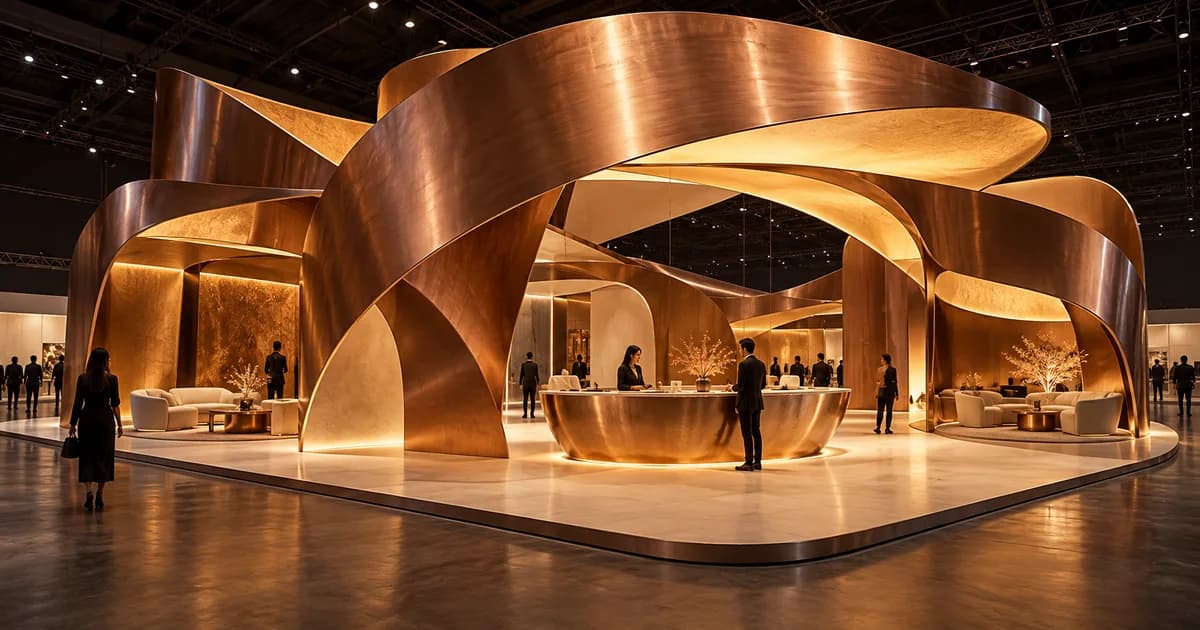
The end of an event should not be the end of its architecture. Sustainable event design begins with a question that rarely appears in a hero render: where will every major component go next? A modular build can still feel specific, dramatic and beautifully finished. Its advantage is not sameness. It is the ability to create a new expression without producing an entirely new object each time.
Why is material reuse a timely priority?
Isla's 2026 report examined more than 6,400 material entries from 789 events held in 2025. It found that 84% of measured materials were virgin. These are findings from a recorded dataset, not a census of every event worldwide. They nevertheless provide a concrete reason to challenge the assumption that a new campaign needs entirely new fabrication.
For a brand team, the practical starting point is an inventory rather than a sustainability slogan. What already exists? Which plinths, frames, counters, lighting fixtures or display systems can serve the new concept? Which pieces need repair, refinishing or different graphics? Knowing that before design development creates options. Discovering it after fabrication has been ordered usually creates compromises.
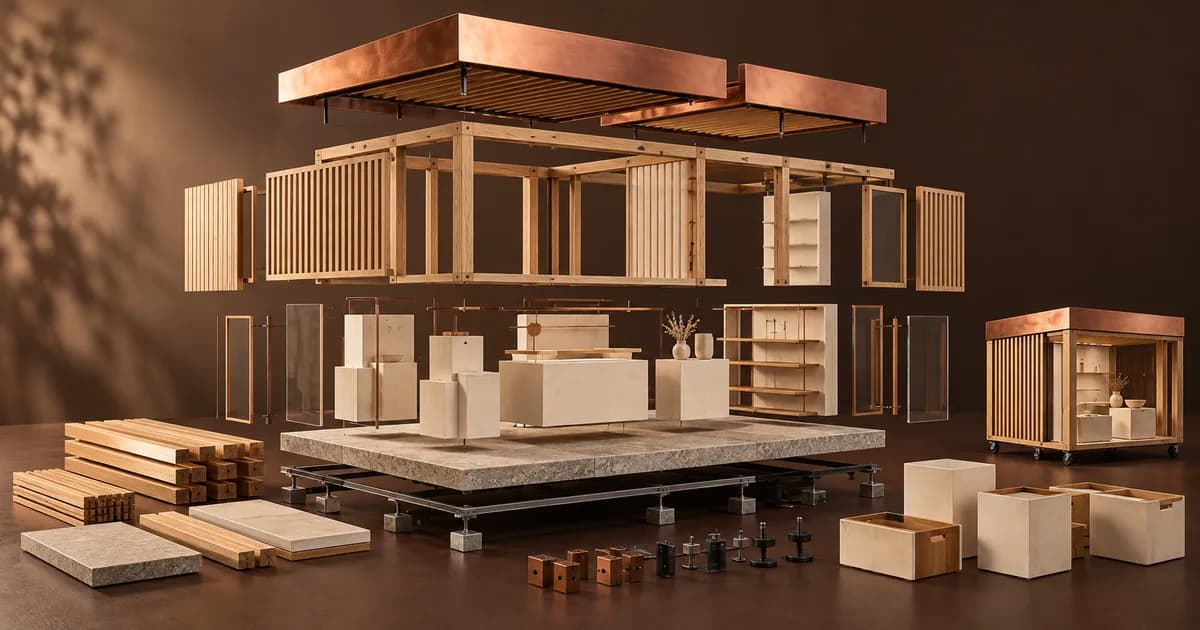
Our production recommendation is to distinguish permanent assets from campaign layers. The load-bearing system, core lighting and transport protection may outlast several campaigns. Graphics, finishes and small feature elements may change more often. That separation lets the brand refresh its visual expression while retaining expensive and material-intensive parts of the build.
There are limits. A component with difficult transport, high refurbishment needs or no realistic second use is not automatically the responsible choice. Compare the whole delivery plan. Reuse needs evidence and coordination, not simply a modular label. Bring those questions into production, contracting and care early enough to affect the specification.
How do you design a modular activation without making it generic?
Keep the connection system consistent and let the visible composition change. Repeated dimensions can support different layouts, while lighting, texture and the guest journey create a distinct identity. Modularity is most useful when it gives designers a reliable kit of parts, not when it forces every site to display the same arrangement.
Imagine a family of freestanding frames that can form a product gallery, an arrival threshold or a smaller consultation area. Change the spacing and infill to suit the venue. Use the same concealed connections where possible, and document the safe configurations. The structural design still requires competent review; creative flexibility cannot be allowed to obscure load or stability requirements.
Prototype the joint, edge and replaceable surface. Those details decide whether the second installation looks intentional or tired. A beautiful panel glued into an inseparable assembly may be harder to recover than a slightly different finish with accessible fixings. Ask the fabricator to demonstrate removal and reassembly, not only the finished appearance.
Our suggested test is simple: can another competent crew identify, unpack and reassemble the intended configuration from the documentation? If the answer depends entirely on the memory of the original team, the system is fragile. Label components, photograph connections and record replacement parts. These modest decisions are what let ambitious design survive the move between sites.
The aftercare plan is part of the build
Assign ownership before the event opens. Someone must decide what is retained, where it is stored and who checks its condition. A reusable set without a storage booking or return transport is a disposal risk. The handover should include the asset inventory, packing instructions, maintenance needs and the budget for the next inspection. Apply the same discipline to exhibition stand planning, where the layout must support demonstrations and conversations as well as future reuse.
Separate breakdown time from clearance time. Crews working against a short venue deadline need a realistic method for removing materials safely. Reusable components can be damaged if the only priority is getting everything out. Plan access, protective packaging and labour around recovery, and agree what happens when a component cannot be returned in usable condition.
The logistics plan deserves the same scrutiny as material selection. Consolidate movements where practical and inspect local sourcing options, but do not assume local automatically means lower impact. The material, production method, transport and expected service life all matter. Use measured information when making environmental claims, and make the boundary of any calculation explicit.
Document the next use as a real scenario: another launch, a retail display or a smaller installation. If that scenario does not exist, consider hiring a suitable system instead of owning a bespoke one. For brands with seasonal programmes, this planning can connect event assets with branded spaces and fit-outs, provided their technical requirements are compatible.
How do you report progress without greenwashing?
Report what you can verify. Useful records include material quantities, reused components, repairs, transport movements and confirmed destinations after breakdown. State what is excluded. A count of recycled panels does not describe the whole footprint, and diverting something from landfill is not the same as proving it will be reused successfully.
Use a consistent unit when comparing events. Component counts can be misleading if small decorative items outnumber heavy structural pieces. Weight, area, service life or another relevant measure may offer a clearer picture. Explain the method so the next campaign can use it again. Avoid comparing unlike builds simply because both were called activations.
The most useful internal report is an asset story: what came from existing stock, what was made, what survived, what was repaired and what is booked for another use. That narrative exposes decisions the team can improve. Pair it with a properly scoped carbon assessment when the brief calls for one, using appropriate expertise and evidence.
For the next brief, start with the recovered inventory and one realistic reuse objective. Ask design and production teams to price the whole life of the system, including storage and refurbishment. This can change the conversation from lowest opening-night cost to longer-term value. The same discipline supports experiential retail, where a short tenancy should not force every material into a short life.
Frequently asked questions
Are modular exhibition stands always more sustainable?
+
No. Benefits depend on actual reuse, material choice, transport, maintenance and storage. A modular system that is discarded after one appearance has not delivered its intended advantage. Compare realistic delivery scenarios and record what happens after the event before making broad claims about environmental performance.
What should be included in a reusable event-build brief?
+
Specify expected future configurations, accessible connections, replaceable finishes, packing, transport, storage and maintenance. Name the asset owner and provide a documented breakdown method. Include inspection before each subsequent use. These requirements give the production team a practical way to deliver reuse rather than an open-ended request to be sustainable.
Does sustainable event design mean a less impressive result?
+
Not necessarily. Reusable structures can support changing light, materials and layouts, while a focused concept can reduce unnecessary fabrication. The trade-off must be assessed for the specific brief. Concentrating effort on a strong focal point can create a more distinctive encounter than adding many short-lived decorative objects.
sustainable event designreusable exhibition standsmodular activationsevent production
Editorial note: research is linked where cited. Recommendations are planning guidance, not reported XR client outcomes. International findings are not presented as Egypt-specific market data.
Explore production & aftercare